Live Daily Broadcast - Today's Live Show: Focusing on the USD/CAD Ahead of CPI and BoC Announcement |
Support, Resistance and Range Forecast |
USD/JPY Daily Outlook |
Forex Market Outlook on Majors |
Forex Daily Overview - USD mixed as jobless claims fall, housing starts plunge |
Market Thoughts - 16/4/2009 - The Current Market Sentiment |
Intraday Forex Technical Report - U.S. Update: Uncertain times |
Recent Recommended Trades |
Forex Market Outlook on Minors/Crosses |
EUR/USD Daily Outlook |
Chart of the Day - Chart of the Day – USD/CHF |
U.S Market Update |
Economics as Strategic Input to Business Decision-Making |
Technical Research - Comprehensive FX and Futures Daily Research |
FX Options trade alert - FX Options trade alert |
Thursday, April 16, 2009
Latest Updated Reports

GET INTO CURRENCY TRADING
Currency trading with dbFX
Mid-Day Report: Markets Mixed as Positive Earnings Offset by Poor Housing Data
Tuesday, April 14, 2009
Stock Market Update
| Market Snapshot | |||
|---|---|---|---|
| Dow | 8057.81 | -25.57 | (-0.32%) |
| Nasdaq | 1653.31 | +0.77 | (+0.05%) |
| SP 500 | 858.73 | +2.17 | (+0.25%) |
| 10-yr Note | +19/32 | 2.85% | |
| NYSE | Adv 1782 | Dec 1264 | Vol 1.48 bln |
| Nasdaq | Adv 1353 | Dec 1358 | Vol 1.83 bln |
US Futures & Markets Indicators
| Jun 2009 | Change | Level | Last Update† | |
|---|---|---|---|---|
 | ||||
| S&P 500 | -3.20 | 850.80 | 4/14 5:00am |  |
| Fair Value | 855.35 | 4/13 10:08pm | ||
| Difference* | -4.55 | |||
| ||||
| NASDAQ | -4.50 | 1327.50 | 4/14 4:29am |  |
| Fair Value | 1335.58 | 4/13 10:08pm | ||
| Difference* | -8.08 | |||
| ||||
| Dow Jones | -15.00 | 7980.00 | 4/14 4:44am |  |
| DJIA Contracts | ||||
FTSE edges up on banks, miners; oils weaken


Monday, April 13, 2009

NASDAQ OMX has Acquired the Boston Stock Exchange
NASDAQ OMX has acquired all of the outstanding membership interests in the Boston Stock Exchange (BSE). With the acquisition, NASDAQ has obtained a second equities trading license allowing for a separate Regulation NMS protected quote, which will be called NASDAQ OMX BX (BX). NASDAQ OMX also has acquired two BSE wholly-owned subsidiaries, Boston Options Regulation, LLC (BOXR) and the BSE Clearing Corporation (BSECC).
NASDAQ OMX has not acquired an interest in BSE’s options trading facility, the Boston Options Exchange (BOX). Instead, BSE’s ownership interest in Boston Options Exchange Group, LLC, the operator of BOX, has been transferred to MX US 2, a wholly-owned subsidiary of the Montreal Exchange Inc. However, BX, through BOXR, will operate as the regulatory services provider to BOX.
The following links provide information about BSE, BSECC, NASDAQ OMX BX, and BOX.
ABOUT THE EXCHANGE

What we do
The London Stock Exchange is at the heart of global financial markets and is home to some of the best companies in the world. Discover how our business is structured and what makes us one of the world's leading equity exchanges.
Sunday, April 12, 2009
FXConverter - Currency Converter for 164 Currencies
Universal Currency Converter
Saturday, April 11, 2009
Trading Cycle in Kuwait Stock Exchange:
2 - A Copy of the civil identification, the name of the bank the client deals with (3 K.D for individuals, 5 K.D for corporate).
3 - Choose one of the registered Brokerage Firms in KSE.
4 - When issuing a selling order, share certificates should be presented the following day after the transaction.
5 - When issuing a buying order, payment should be submitted to the broker the following day before 11:00 am if the client’s balance with KCC is insufficient.
6 - Commission is calculated 1.250 K.D for each one Thousand K.D, commission is calculated 1 K.D for each one Thousand K.D for transaction of Fifty Thousand K.D and above.
7 - A cheque will be issued by KCC in favor of the client every Sunday and Wednesday.
8 - KSE account is accredited 500 fils for each executed transaction.
9 - Share prices can fluctuate 5 pricing units daily according to its category.
Daily OANDA Forex Blog (Apr 10, 2009 at 05:19:47am) — by Dean Popplewell
Global stocks received a boost yesterday from a number of sources. Firstly, a positive article in the NY Times stated that all 19-US banks subjected to FDIC’s stress tests to determine their viability will pass the review, even if some lenders require additional capital. Perhaps US banks may be healthier than originally anticipated or is this just ‘window dressing’ to fuel consumer confidence? Secondly, good ‘old’ Wells Fargo earning $3b in the 1st Q topping the streets estimates added further momentum. Thin markets and an early close were capable of pushing the EUR to extremes yesterday just before traders left for the long weekend, a nice Easter present, squeezing all those longs out!
The US$ is stronger in the O/N trading session. Currently it is higher against 13 of the 16 most actively traded currencies, in a ‘subdued’ trading range.
Some surprise in yesterdays ‘slew of data’ this side of the pond. US trade will contribute positively to the 1st Q (-26b vs. -36.6b)....
For more Forex Market Commentaries visit OANDA Forex Blog
Friday, April 10, 2009
FDIC moves in on Cape Fear

North Carolina bank is 22nd to fail this year.
Earnings, meet rally
Results from Citigroup, Goldman Sachs
and J.P. Morgan will test the recent run-up.
• Goldman's multibillion-dollar offering
• Less is Morgan: Fears of red ink on rise
U.S. budget in a hole
Deficit is well on its way to $1.75 trillion that White House estimated for full fiscal year.
• $1 trillion public-private fund evolving
• President Obama: Hope amid distress
• MarketWatch's top stories of the week
Monday, March 30, 2009
Sun Pharma Gets USFDA Nod To Market Generic Topamax Tabs; Stock Up 2.1%

Sun Pharmaceutical Industries announced that it has secured final approval from US Food and Drug Administration (USFDA) for its abbreviated new drug application (ANDA) to market generic Topamax, topiramate tablets.
Topiramate, is a generic version of epilepsy drug Topamax, owned by Ortho-McNeil Pharmaceutical Inc, a division of Johnson & Johnson.
The tablets are available in four different potencies including 25 mg, 50 mg, 100 mg, and 200 mg.
The twelve-monthly sales of Topamax tabs stood at $2.5 billion in the US.
Topiramate, an anticonvulsant drug, is prescribed for the treatment of epilepsy in both children and adults.
In the majority of cases, the drug can also be used as an antidepressant, most of the time for depressive realism.
In kids, it is also prescribed for treatment of Lennox-Gastaut syndrome, a disorder that causes seizures and developmental delay.
It has been used by psychiatrists to cure bipolar disorder, although it is not FDA approved for this purpose. This drug has been investigated for use in treatment of obesity, especially to aid in the reduction of binge eating, and also as a possible treatment for alcoholism.
The drug is also used in clinical trials to treat Post Traumatic Stress Disorder.
At 01:14 p.m., the company’s stock gained 2.1% at Rs 1,102 on the Bombay Stock Exchange (BSE). The total volume of shares traded was 17,212. The share price has seen a 52-week high of Rs 1,539.90 and a low of Rs 953 on BSE.
GLOBAL MARKETS-Stocks fall, euro tumbles on German warning

By Burton Frierson
NEW YORK, March 27 (Reuters) - Stock prices fell around the globe on Friday as investors decided to take the money and run after a stunning 20-percent rally from lows earlier this month, while political strains punished the euro.
The euro suffered its biggest one-day loss against the dollar in more than two months after Germany's finance minister said fiscal irresponsibility in Europe could put the currency at risk.
A stronger dollar hurt oil and gold. As has often been the case since the start of the economic crisis, the rising dollar also coincided with weakening stocks.
Profit-taking explained much of the slide in New York, Europe and Tokyo in the wake of what many suspect was just a bear-market rally. Whatever the case, the stock market may be in for a period of reassessment.
"After the significant rallies, you will see these types of pullbacks," said David Sowerby, market strategist for Loomis Sayles in Detroit. "There remains significant macro uncertainty on consumer spending although the micro news has gotten marginally better."
In early afternoon trading, the Dow Jones industrial average .DJI was down 110.87 points, or 1.40 percent, at 7,813.69. The Standard & Poor's 500 Index .SPX was off 11.16 points, or 1.34 percent, at 821.70. The Nasdaq Composite Index .IXIC was down 25.87 points, or 1.63 percent, at 1,561.13.
Ex-minister nominated to head Mexico's stock market

MEXICO CITY, March 25 (Reuters) - The controlling shareholders of Mexico City's stock market nominated former government minister Luis Tellez as the exchange's president, the stock market said on Wednesday.
Tellez, an economist, served as Energy Secretary under President Ernesto Zedillo and was managing director of private equity firm The Carlyle Group's [CYL.UL] Mexico offices.
Most recently he served as Transport Minister in the current government of Felipe Calderon until he stepped down from his post earlier this month following a scandal over recorded personal telephone calls [ID:nN03496093].
The Bolsa Mexicana de Valores BOLSA.MX, or BMV, went public last June and the exchange is jointly owned by more than 30 brokerages that use it to trade stock, derivatives and debt. (Reporting by Robert Campbell; Editing by Carol Bishopric)
SEC Seeks to Revive Stock Market with Tax Incentives

The Securities and Exchange Commission (SEC) has said tax rates on investments in the capital market need to be reviewed downward by the necessary authorities to douse the tension arising from the global financial meltdown and restore investors’ confidence in the market.
Also, the Council of The Nigerian Stock Exchange (NSE) has announced the suspension of Nova Finance & Securities Limited for manipulating the share price of African Petroleum (AP) Plc.
The downward review of tax rates, which is being canvassed as part of incentives, would also help the capital market to make quick recovery, SEC said.
The Director-General, Mr. Musa Al-Faki, said at the round table forum on tax incentives and waivers in the Nigerian capital market, which held yesterday in Abuja, that the participants should consider the role tax incentives could play in bringing about a faster pace of discovery for the market as well as ensuring its stability and sustainable growth in the future.
He said: “Investors in our market are still charged a 10 per cent withholding tax on dividends they receive on their investments irrespective of how much the dividend is.
“This is in addition to the value added tax (VAT) and other taxes charged issuers of securities in the primary market and on transactions in the secondary market.”
Al-Faki emphasised the need to consider the role of tax incentives in reviving the capital market and ensuring its sustainable growth as well as a tax regime that would encourage sustained investments in the capital market.
He also canvassed the need for the government and all stakeholders to evolve strategies towards inducing the recovery and development of Nigeria’s capital market as well as strengthening its global competitiveness for inflow of funds from other countries.
Al-Faki noted that on its own, SEC had since the eruption of the global economic crisis constituted two industry-wide committees to review the market structure and procedures as well as the code of corporate governance.
Al-Faki gave assurances that the recommendations of the committees shall be vigorously implemented by the Commission.
The market has lost N8 trillion or 63 per cent in terms of market capitalisation since the meltdown began March 6, 2008.
The market capitalisation has fallen from N12.6 trillion to close at N4.6 trillion, while the index depreciated from a peak of 66,371.20 to below 20,000.
Confessions of a Money Manager: Geithner's gambit powering stock market
week
about the genesis of Treasury Secretary Tim Geithner's new program that it would ignite a 500-point burst for the Dow Jones Industrial Average when Geithner unveiled it Monday.
Walkenhorst told me that existing and newly formed private investment firms were being courted to participate in a market -- buying and selling -- for the toxic loans that are clogging the nation's banking system.
Geithner's newly announced financial rescue plan now includes what are called public-private investment partnerships. Before I go any further, let me tell you that Geithner's newly created partnerships have come under instant attack by such notable economists as Nobel Prize winners Joseph Stiglitz and Paul Krugman. They say the new plan is a gimmick that allows speculators to use taxpayer money to buy and sell toxic assets for a potential profit. Well, they're right.
However, making deals with speculators may be the only way that taxpayers will be spared from shoveling more bailout money to those debt-riddled banks. So before we make judgments, let's see the devilish details of this proposal.
We all know that major banks hold assets: packages of mortgages, consumer debt, car loans, and the like. We all know that the banks are earning some interest on these packaged loans, but the potential for default has made these loan packages toxic. Buyers are bidding 30 cents on the dollar, sellers are fearful of selling at such low prices that the mark-to-market accounting requirement would instantly impair the loans not sold and could force technical bankruptcy by the accounting loss of equity. So we have an impasse.
The government wants to buy these loans via funds provided by the Federal Reserve, the U.S. Treasury, and now the Federal Deposit Insurance Corporation, and the banks want to sell them. The problem is determining a true market price.
In steps, the public-private investment partnerships will invest some of their money -- 7 percent -- and the government's money -- 93 percent -- to buy the loans and, in essence, make a market in these toxic assets. What are the mechanics of this plan? Organized mayhem.
Remember that great movie "The Hustler"? The three principal players in this mayhem will be bank lending officers, partnership speculators, and government officials. Think of Jackie Gleason as the banker, George C. Scott as the government guy bankrolling the speculator, Paul Newman. They play pool for high stakes. Under Geithner's plan, these guys will be playing on boardroom tables, sifting through the lending documents, and exchanging bids and offers on loans. The Gleason bankers will want top dollar for their loans, the Newman speculators will haggle for lower prices, and the George C. Scott government guys will put up the bulk of the money to make the trades possible.
The persistent rally of stock market
finishing 12.06% or 1,081.81 points higher, and the Nifty
ending 10.74% up. The CNX
Midcap Index underperformed the main indices with a relatively modest gain of 5.77%.
Tata Steel was the biggest winner among the index stocks with a 26.9% gain. The other index stocks to go up included ICICI Bank, HDFC Bank, Sterlite Industries and State Bank with gains falling between 19.3% and 18.0%. None of the index stocks declined last week.
Unitech was the biggest winner among the more heavily traded non-index stocks with a 33.2% gain. The other non-index stocks to go up included PNB, Aban Offshore, Lanco Infratech, Axis Bank, Sesa Goa, JSW Steel and Yes Bank with gains falling between 32.4% and 23.6%.
Akruti City was the biggest loser among the more heavily traded non-index stocks with a 51.6% loss. The other non-index stocks to go down included Edserv Softsystems, MindTree, Crompton Greaves, Tulip Telecom, Everonn Systems , Firstsource Solutions and Gujarat NRE Coke with losses falling between 22.1% and 2.9%.
Intermediate Trend
The market remains in the intermediate uptrend which started on March 6 when the Sensitive Index made a bottom at 8,047. The levels below which the uptrend would end are now a considerable distance down at 8,867 for the Sensitive Index, 2,739 for the Nifty and 3,190 for the CNX Midcap Index.
These would be revised upwards to the level where the next minor decline bottoms out. Most global markets are in fairly strong intermediate uptrends, and are typically somewhere between their one-month and three-month highs.
Long-Term Trend
The market's long-term trend is down. The index has been in a 3,300-point range between 7,700 and 11,000 since the end of October, without any clear sequence of rising or falling tops and bottoms. It would therefore be best to take 11,000 as the level to cross for the Sensitive Index for a bull market confirmation. The corresponding level for the Nifty is 3,250, and that for the CNX Midcap Index is 4,000. (Figures have been rounded upwards).
Almost 25% of the market's heavily traded stocks are now at two-month highs or better, and over 15% are above their 200-day moving averages. These could be the first signs that the bear phase may have already ended. In any event, quite a few stocks may have already left the worst behind them.
Trading & Investing Strategies
The market is currently in an intermediate uptrend, and long-term investing should be put on hold until the next intermediate downtrend develops and has run for a week or two. It will be a good idea to hold on to past and recent investments, and not get out of them as this rally progresses. This portfolio building exercise suggested over the last few months is simply to buy stocks at low levels, and not in anticipation of an early end to the bear market - even though this now looks like a distinct possibility.
Global Perspective
The major trends of all global markets remain down, but the intermediate trends of almost all the markets are up. The Dow would enter a bull market (major uptrend) if it were to climb above 9,500. The Shanghai Index has crossed its 200-day moving average, and a global bull phase will become a real possibility if other indices follow suit.
The BSE Sensitive Index had lost 37.5% in the twelve months that ended on Thursday, keeping it at the 21st place among 35 wellknown global indices considered for the study. Chile continues to head the list, but with a 11.6% loss. New Zealand, South Korea, Israel and Spain follow. The Dow Jones Industrial Average has lost 35.6% and the NASDAQ Composite has lost 30.4% over the same period. (These rankings do not take exchange rate effects into consideration).
Stock Market Game: Champion good as gold with big finish for victory
He didn’t take the lead until the last day of trading.
“What counts is who is leading on lap 500,” he said.
But, in Eck’s case, the win might have just as much in common with winning a gold medal.
Eck, 63, of North Fort Myers, posted a gain of $13,359.76 over the eight-week contest to beat more than 1,800 competitors and win the $500 prize.
The game asks participants to invest $50,000 in play money in five stocks, buying only whole shares.
There is no trading during the eight weeks of the game and the contestant with the largest gain over their initial investment is the winner. School classrooms compete in a separate contest for $250.
Eck’s portfolio, like most of the top 10, was weighted in gold mining stocks. His biggest winner was The Seabridge Gold Corp., a Canadian mining exploration company. The stock value gained 58 percent in the eight weeks of the contest.
“I looked for what would go up in a down market,” Eck said. “Then, I just had to put those picks against the others who went with gold.”
The major market indexes all declined during the span of the game, with the Standard & Poors 500 Index down the most at about 7.6 percent.
In that challenging environment, just 387 contestants — a little more than one in five —
Vanguard Total Stock Market ETF (VTI) PriceWatch Alert With $37.56
MLB Stock Market
Now that Spring is finally ending -- although I've got money on it snowing again here in Toronto even after the first pitch is thrown in April -- I am hopeful that there will soon actually be stuff to talk about! If I'm wrong about there being Stuff to Talk About, then you can expect a multitude of crazy-ass articles like the one I wrote last Thursday. So maybe from the perspective of your bemusement and my loss of credibility, you are rooting for my hopes to be wrong. If that's the case, then I can only shake my fist at you.
There, I'm done shaking. And now on to the Stock Market portion of this article...
Rising
Kevin Gregg's save opportunities
Personally, I'm opposed to this one for a number of reasons. Unlike many Cub fans, I have few doubts that Gregg can be a good closer. That's not the issue. And like many Cub fans, I believe Carlos Marmol is one of - if not the - best setup man in baseball. The reason I'm opposed to this, though, is because Marmol's arm is going to get wasted by Piniella as the setup man. I don't mean wasted in the sense of "an opportunity wasted," but instead in the sense that Lou Piniella will pitch Marmol until his arm detaches from its shoulder.
My only point is that if Marmol closes, then Lou will be less likely to pitch him in multiple innings on multiple days in a row. Marmol lost his command and effectiveness last year when Lou was using him the most. If the Cubs want Marmol to stay healthy and happy, then they should have made him the closer.
The expectations placed on Zack Greinke
Some crazy mo-fo's actually think the Royals might have a chance to be a Dark Horse team in the AL Central. (Don't tell anybody, but I'm one of them.) To pile onto the surprise pressure, there's talk that Royals ace Zack Greinke - who'd be lucky to pitch in the opening series of the season for a team like the Yankees, but I digress - might be a Dark Horse Cy Young candidate. There's no doubting that Greinke is a good pitcher, but as somebody who's only ever thrown more than 200 innings once in his career Cy Young expectations might be just a bit unfair.
Regardless, with all this talk about them being the stealth favorites, maybe the Royals should just cut to the chase and make George Harrison's Dark Horse album the team theme for the season.
Holding
Probatin' Miguel Tejada
If I see Miguel Tejada play a game this season, I will loudly start a chant in which he is called "Probie" a lot. Or maybe not. It's really not a good insult name. But in his case it actually fits - Tejada avoided stiff consequences for lying to Congress about the use of steroids by recently receiving a year's probation. After the sentence was passed down, Tejada was seen walking from court with a massive blunt in his mouth and two hookers on each arm. When asked to comment, he reportedly said "guess I'm bullet proof," laughed, and shot a homeless guy dead right there on the street.
Actually he acted very humble. I'm a little surprised that Raffy Palmeiro remains nowhere to be seen. After he was found to have tested postive for 'roids, the Raff said that he did nothing wrong except receive an injection of B12 from Tejada. People scoffed at his excuse, but guess who got caught doing steroids?
Bernie Williams' interest in playing ball
It's been two seasons since Williams last donned a Yankees cap. After New York expressed no interest in keeping him aboard, Williams hung up his jersey for the last time until this Spring, when he played in the WBC for Puerto Rico. Apparently that little taste of baseball was all it took and Williams now wants to return.
Williams is one of my favorite Yankees. I respect any guy who gets to spend his career with one team. He played 16 seasons in New York, won a ton of rings, hit 22 post season taters, and comes nowhere near being a Hall of Fame candidate. If he can manage to return, I hope for his legacy's sake that it's with the Yankees. He may otherwise come to regret it. Just ask Ron Santo.
US Stocks Higher On Banks, Industrials Though Tech Weak
Weighing on stocks in recent trading was a weak five-year Treasury note auction, with a lack of foreign investors coming to the table.
The Dow Jones Industrial Average was up about 28 points after a 116-point decline in the previous session. Alcoa, Bank of America, JPMorgan and Boeing were among the gauge's best-performing stocks.
The S&P 500-stock index rose 0.5% as its financial sector increased 2%, though utilities and technology companies declined. The Nasdaq Composite Index advanced 0.3%.
Recent data, particularly on housing, have hinted at a possible moderation in the recession. Data Wednesday showed new-home sales climbed for the first time in seven months in February. The inventory of homes for sale fell to its lowest since June 2002 - a sign the market may be stabilizing. Earlier this week, a report said existing-home sales jumped last month.
For more than a year, market veterans have maintained the housing sector would have to stabilize before the broader economy and the stock market.
"The key is that this wasn't just a one-off number on housing. There is improvement and we're seeing strength in industrial names. A broker could downgrade a group, and they still go up," said Kevin Kruszenski, director of equity trading for KeyBanc Capital Markets.
The housing report pushed up builders' stocks, as the SPDR S&P Homebuilders ETF jumped 5%. The fund has gained 19% over the last month amid the wider improvement in the stock market. Toll Brothers rose 5% and D.R. Horton surged 7.5% in recent trading.
Industrial stocks got a boost after the Commerce Department said orders for longer-lasting manufactured goods rose 3.4% in February after a revised 7.3% skid in January. Economists expected a 2% skid. Orders for non-defense capital goods excluding aircraft, a barometer of business spending, rose 6.6% after plunging a downwardly revised 11.3% in January.
A round of solid gains for stocks this week, highlighted by a nearly 500-point surge in the Dow on Monday, have boosted traders' confidence the end of the long-running bear market may be in sight.
"We really seem to be climbing a wall of worry this time, which wasn't the case during the earlier bear-market rallies we've seen," said Roger Volz, director of equities at BGC Financial in New York.
John Wilson, technical analyst at Morgan Keegan, said he is encouraged by the dwindling number of stocks on the New York Stock Exchange making new lows. He noted about 2,900 stocks hit new lows in October, while in early March that number sank to around 800.
Trader Jon Najarian, of OptionMonster Holdings in Chicago, said one of the most encouraging aspects of the market's recent rally from bear-market lows has been the presence of strong volume in stocks and options. Robust trading activity is often a sign of strong investor conviction that a lasting market trend is in place.
For the full trading session Tuesday, composite volume in New York Stock Exchange-listed names was 6.7 billion shares, compared to the daily average of 6.2 billion so far this year.
MARKET SNAPSHOT: U.S. Stock Rally Faces Jobs, Earnings, G20 Hurdles

A huge three-week rally in stocks will meet a number of stumbling blocks next week, including some earnings, a meeting of finance ministers and central bankers from the G20, as well as the key jobs report for March.
Congress will also be hearing comments on key proposals to change to mark-to- market accounting.
"We've had the largest three-week move in stocks since 1938," said Hugh Johnson, chairman of Johnson Illington Advisors. "It's probably asking for a lot that the market continue to move higher over the next three weeks. We have some formidable challenges coming up ahead, and it would seem that it's time for a breather."
On Friday, stocks fell but still closed a strong week of gains. The Dow Jones Industrial Average fell 148 points, or 1.9%, to end at 7,776. The S&P 500 Index fell 16 points, or 2%, to end at 815, while the Nasdaq Composite Index (RIXF) lost 41 points, or 2.6%, to end at 1,545.
For the week, the Dow rallied 6.8%, the S&P 500 gained 6.2% and the Nasdaq rose 6%. For the month so far, the Dow is up 10.1%, the S&P is up 11% and the Nasdaq adds 12.2%.
The S&P 500, which investing professionals use as the benchmark of the broad market, scored its best 14-day gains since July 1938.
But some of the stock market's reactions on Friday led some to believe that the rally might be long in the tooth ahead of the first-quarter earnings reporting season.
"Back in February and early March, we had a number of banks coming out with upbeat quarterly results and forecasts, and that helped spark the rally," said Owen Fitzpatrick, head of U.S. equities at Deutsche Bank.
"But even if it got a bit better in March, overall industrial activity has remained weak and that will translate into weak earnings and companies taking down their forecasts," he added. "This will throw a little bit of cold water on this rally."
Investors agonize: Is it time to get back into stocks?

Jin Lee / Bloomberg News
A trader looks at a monitor at the New York Stock Exchange. Since hitting a 12-year low March 9, the Dow Jones industrial average is up more than 1,200 points, or about 19%.
They're worried that a striking rally in the last three weeks will prove ephemeral. But they also fear that they could be missing out on a huge -- and real -- market recovery.
By Walter Hamilton
March 28, 2009
Reporting from New York -- David Preefer sold his entire stock portfolio last summer because he feared that share prices, already down sharply from record highs reached in 2007, still had a lot further to fall.
It turned out he was right. But a striking rally in the last three weeks has the retired lawyer and many other investors across the country asking themselves: Is it time to
Asian Stocks Rise as Index Enters Bull Market; Hutchison Jumps

March 26 (Bloomberg) -- Asian stocks climbed, extending the regional benchmark index’s biggest monthly rally since 1998, on better-than-estimated U.S. economic reports and earnings from Hutchison Whampoa Ltd. U.S. futures advanced.
The MSCI Asia Pacific Index has rallied 21 percent from a five-year low on March 9, technically entering a bull market. Sony Corp., which gets a quarter of its sales from the U.S., surged 7.4 percent in Tokyo after U.S. durable-goods orders rose the most in more than a year. Hong Kong’s Hutchison, billionaire Li Ka-shing’s biggest company, added 3.3 percent. Industrial & Commercial Bank of China Ltd. soared 15 percent as Goldman Sachs Group Inc. agreed to extend a lockup on its shareholding.
“The stock market has entered a path to recovery,” said Yoshihiro Ito, senior strategist at Tokyo-based Okasan Asset Management Co., which oversees about $9.3 billion. “The better- than-expected U.S. indicators signal the bottoming out of the global economy.”
The MSCI Asia Pacific Index rose 1.5 percent to 85.60 as of 7:16 p.m. in Tokyo. The gauge jumped 14 percent in March, the biggest monthly gain since October 1998, when governments were cutting interest rates to alleviate the Asian financial crisis.
Japan’s Nikkei 225 Stock Average gained 1.8 percent, while Hong Kong’s Hang Seng Index rose 3.6 percent. Australia’s S&P/ASX 200 Index advanced 1 percent as the central bank said the country wasn’t at risk of a U.S.-style subprime crisis. All markets advanced except New Zealand and Sri Lanka.
Beating Expectations
Elpida Memory Inc., Japan’s biggest maker of computer- memory chips, surged 18 percent on optimism share sales units will help it avoid early repayment of loans. Hynix Semiconductor Inc. soared 15 percent in Seoul after saying production cuts will lead chipmakers to a better second half this year. Li & Fung Ltd., which supplies clothes and toys to Wal-Mart Stores Inc., fell 4.7 percent in Hong Kong on lower profit.
Futures on the Standard & Poor’s 500 Index climbed 0.9 percent today. The gauge gained 1 percent yesterday as government reports showed February orders for U.S. durable goods gained the most since December 2007, while sales of new homes increased last month from a record-low pace in January. Economists had expected both figures to decline.
Sony, the world’s second-biggest maker of consumer electronics, jumped 7.4 percent to 2,215 yen. Merrill Lynch & Co. upgraded the stock to “buy” from “neutral,” saying the company’s reorganization would boost earnings.
Asian Stocks Rise as Index Enters Bull Market; Hutchison Jumps
The MSCI Asia Pacific Index has rallied 21 percent from a five-year low on March 9, technically entering a bull market. Sony Corp., which gets a quarter of its sales from the U.S., surged 7.4 percent in Tokyo after U.S. durable-goods orders rose the most in more than a year. Hong Kong’s Hutchison, billionaire Li Ka-shing’s biggest company, added 3.3 percent. Industrial & Commercial Bank of China Ltd. soared 15 percent as Goldman Sachs Group Inc. agreed to extend a lockup on its shareholding.
“The stock market has entered a path to recovery,” said Yoshihiro Ito, senior strategist at Tokyo-based Okasan Asset Management Co., which oversees about $9.3 billion. “The better- than-expected U.S. indicators signal the bottoming out of the global economy.”
The MSCI Asia Pacific Index rose 1.5 percent to 85.60 as of 7:16 p.m. in Tokyo. The gauge jumped 14 percent in March, the biggest monthly gain since October 1998, when governments were cutting interest rates to alleviate the Asian financial crisis.
Japan’s Nikkei 225 Stock Average gained 1.8 percent, while Hong Kong’s Hang Seng Index rose 3.6 percent. Australia’s S&P/ASX 200 Index advanced 1 percent as the central bank said the country wasn’t at risk of a U.S.-style subprime crisis. All markets advanced except New Zealand and Sri Lanka.
Beating Expectations
Elpida Memory Inc., Japan’s biggest maker of computer- memory chips, surged 18 percent on optimism share sales units will help it avoid early repayment of loans. Hynix Semiconductor Inc. soared 15 percent in Seoul after saying production cuts will lead chipmakers to a better second half this year. Li & Fung Ltd., which supplies clothes and toys to Wal-Mart Stores Inc., fell 4.7 percent in Hong Kong on lower profit.
Futures on the Standard & Poor’s 500 Index climbed 0.9 percent today. The gauge gained 1 percent yesterday as government reports showed February orders for U.S. durable goods gained the most since December 2007, while sales of new homes increased last month from a record-low pace in January. Economists had expected both figures to decline.
Sony, the world’s second-biggest maker of consumer electronics, jumped 7.4 percent to 2,215 yen. Merrill Lynch & Co. upgraded the stock to “buy” from “neutral,” saying the company’s reorganization would boost earnings.
‘Superman’ Li
Canon Inc., the world’s largest camera maker, climbed 3.5 percent to 2,965 yen. Samsung Electronics Co., the world’s biggest maker of computer memory, rose 2.5 percent to 570,000 won in Seoul.
“The landslide-like deterioration of the global economy has halted,” Juichi Wako, a strategist at Tokyo-based Nomura Securities Co., said in an interview with Bloomberg Television. “We’ve seen continued resilience in the market.”
Stocks have rallied this month as the U.S. and Japan pledged to buy government debt to boost lending and banks including Standard Chartered Plc reported strong starts to the year. The U.S. Treasury three days ago announced plans to rid banks of toxic-real estate assets.
Gains in stocks raised the average valuation of companies on the MSCI Asia Pacific Index yesterday to 16.4 times profit, the highest level since December 2007, data compiled by Bloomberg show.
The gains pared the index’s drop this year to 4.4 percent, while the MSCI World Index lost 9.8 percent. Both are set for their sixth-straight quarterly declines. Hutchison’s Li, dubbed ‘Superman’ by local media because of investment acumen, told reporters in Hong Kong that he couldn’t say if the stock market had bottomed yet.
Irvine Sensors to Formalize Withdrawal of Boston Stock Exchange Listing
Irvine Sensors Corporation (www.irvine-sensors.com), headquartered in Costa Mesa, California, is a vision systems company engaged in the development and sale of miniaturized infrared and electro-optical cameras, image processors and stacked chip assemblies and research and development related to high density electronics, miniaturized sensors, optical interconnection technology, high speed network security, image processing and low-power analog and mixed-signal integrated circuits for diverse systems applications.
Safe Harbor Statement under the Private Securities Litigation Reform Act of 1995: This message may contain forward-looking statements based on our current expectations, estimates and projections about our industry, management's beliefs, and certain assumptions made by us. Words such as ''anticipates,'' ''expects,'' ''intends,'' ''plans,'' ''believes,'' ''seeks,'' ''estimates,'' "think", ''may,'' ''will'' and variations of these words or similar expressions are intended to identify forward-looking statements. These statements include, but are not limited to, the timing of the Form 25 filing and effectiveness of withdrawal from the BSE, and the Company's ability to remain listed on the Nasdaq Capital Market and registered with the SEC. Such statements speak only as of the date hereof and are subject to change. We undertake no obligation to revise or update publicly any forward-looking statements for any reason. These statements are not guarantees of future performance and are subject to certain risks, uncertainties and assumptions that are difficult to predict. Therefore, our actual results could differ materially and adversely from those expressed in any forward-looking statements as a result of various factors.
Important factors that may cause such a difference include, but are not limited to, the Company's ability to remain listed on the Nasdaq Capital Market and registered with the SEC; the Company's ability to successfully specify, develop or acquire, complete, introduce, market and transition to volume production new products and technologies in a cost-effective and timely manner; the impact of competing technologies and products; the rate at which current or future customers adopt our technologies; the Company's cash resources and the effectiveness of our expense and cost control and reduction efforts; the effects of international conflicts, natural disasters and other events beyond our control; and the general economic, political and market conditions and specific conditions that may impact our operations. Further information on Irvine Sensors Corporation, including additional risk factors that may affect our forward-looking statements, is contained in our Annual Report on Form 10-K, our Quarterly Reports on Form 10-Q, our Current Reports on Form 8-K and our other SEC filings that are available through the SEC's website (www.sec.gov).
Stock market finishes higher for third week, despite a Friday fall

Caution reasserted itself on Wall Street, sending stocks lower but not enough to stop the market from notching its third consecutive weekly advance.
Major indexes fell about 2 percent Friday, but many analysts said the pullback was a predictable response to the powerful climb this month.
"There is still a definite caution in the air," said Doreen Mogavero, president of Mogavero, Lee & Co., a New York floor brokerage, adding that she's noted some hesitance among her clients.
Mogavero said the money that has gone into the market over the last few weeks has been "short-term" in nature, which leads her to believe that most people are not convinced that the economy will soon recover.
Many analysts believe back-and-forth trading as was seen this week is a healthy way for stocks to recover, because it reflects a conservative rather than euphoric attitude among investors. "I wouldn't read too much into a down Friday," said Sam Stovall, chief investment strategist, U.S. equity research at Standard & Poor's. "It's simply investors taking profits."
Although the gains of the past three weeks have been based on early signs of improvement in the banking system and the economy, those advances are vulnerable to critical economic data due next week and first-quarter earnings reports that will begin in a few weeks.
You've got a lot of fear going into earnings," said John Nichol, manager of the Federated Equity Income Fund. "You need growth and there's just not a lot of growth right now."
The Dow Jones industrial average fell 148.38, or 1.9 percent, to 7776.18.
The Standard & Poor's 500 index fell 16.92, or 2 percent, to 815.94 and the Nasdaq composite index dropped 41.80, or 2.6 percent, to 1545.20. Despite the decline, the indexes look better than they did a month ago:
•The Dow is up 17.3 percent in the last three weeks, its best gain since September 1982 and its longest string of advances since May.
•The S&P 500 has soared 20.6 percent over the past 14 trading days, its best run over that length of time since 1938.
Still, the market has a long way to go. The Dow is down 6388.35, or 45.1 percent, from its record close of 14,164.53 reached Oct. 9, 2007.
Free Share Trading Demo Account
Live market prices stream into the trading software. Just click on a price to trade indices or shares - including S&P 500, Dow Jones Industrials, DAX 30, IBM, Vodafone, Microsoft, and many more.
Comprehensive account-statements, real-time Account Balance tracking and live charts and quotes.
Complete the form below to try a Free demo account now! Login instructions and Password will appear immediately
Thursday, March 26, 2009
financial system of Pakistan ( in Pakistan: Finance )
ISE gains 1.52 points
Pakistan's Stock Exchange Needs Life Support
When I spoke to Karachi Stock Exchange CEO and managing director Adnan Afridi about 10 days ago, the plan was to remove the floor and allow normal trading to resume by now. But the October 27 deadline has passed and things have been pushed back until the end of the month, ostensibly to give the government enough time to tee up a stock market stabilization package. worth about $600 million. That’s right, just $600 million, not billion. That may sound like chump change compared to the mammoth bailouts U.S. and European governments are coughing up, but Afridi says the package should do the trick. About 40% will be used to invest in seven state-owned companies [call it reverse privatization] and 60% will go to financing a put option available to foreign investors who can buy it to minimize further losses when the market goes south.
What I can’t figure out is how they are going to price this put option. Considering the stock market has been in paralysis for two months while other bourses have plunged, the KSE has at least 30% to fall just to catch up with the rest of the pack. The KSE is only down less than 35% so far this year. But the longer the authorities delay the lifting of the price floor, the further things will fall once normal trading does resume. And then there’s an additional downside for the country risk—both because of its highly unstable security situation, and the fact that Pakistan may be just days away from seeking an IMF bailout.
The Exchange welcomes Lancashire Holdings to the Main Market

Speciality insurance provider moves up from AIM to the Main Market.
Lehman Brothers International (Europe) - default information
Information provided by the London Stock Exchange on the default declared on 15 September 2008.
Teathers Limited - default information
Information provided by the London Stock Exchange on the default declared on 25 November 2008 at 17:00 hours.
AIM expands its global reach
AIM Italia, to be launched by Borsa Italiana and a new growth market to be launched in Japan, in partnership with the Tokyo Stock Exchange.
Exchange Traded CFDs
The Exchange is introducing a new service enabling participants to trade Contracts for Difference (CFDs) on the SETS order book.
Earlier opening time for the International Order Book (IOB)
As from 23 February 2009, we have introduced an earlier opening time for the IOB, to create additional trading opportunities and facilitate the continued growth of the market.
Help clear my confusion over Vedanta, ZCI and Anglo?
Maybe these things aren't connected and maybe I am the only one who doesn't understand what's going on?
Andrew Sardanis' book 'A Venture in Africa' seems to tell a large part of the story, but the free Amazon browser cuts short just as we get to the intersting bit, and I think he is basically arguing the whole thing is murky! I've ordered a copy and will report back on what it says if this conversation gets going. If anyone has contact details for Mr Sardanis, I'd be interested to try and include him in the conversation.
Anyway, here's a summary of my muddled thoughts - much of the history here might be wrong or completely irrelevant. Anyone who can clarify any of it is very welcome to add something to comments, or to write a guest entry for the blog to replace this one.
Rare volumes outperform gold, diamonds and stocks
Where the smart money flows, celebrities are sure to follow. Among well-known bibliophiles, Carter Burden Jr., New York political hopeful and socialite, is reportedly amassing what experts believe will be the definitive collection of contemporary American first editions. Author Ray Bradbury favors such English novelists as Somerset Maugham and Evelyn Waugh, and Bestseller Irving Wallace collects rarer chart toppers like a signed edition of The Thin Man, for which he paid $ 1,500 last year.
Their acquisitions in turn have stimulated new interest, in every sense of the word. A first edition of D.H. Lawrence's 1915 The Rainbow bought in 1960 for $25 sold 17 years later for $200. Raymond Chandler's classic whodunit The Big Sleep now brings $2,500, up 150% in five years, and John Irving's early novel Setting Free the Bears, bought twelve years ago for $5.95, is worth $200.
Dealers have responded to such appreciation with come-ons as enticing as those of any money fund. John Jenkins lures the blue-chip set to his $20 million inventory in Austin with tax tips: a collection of rare books that cost $50,000 to build, he points out, can be donated to a library and deducted from taxes at the current value. So the collecting is free, and the gift may be named for the donor: immortality at discount prices. Concludes Jenkins: "All an investor needs is patience, a good adviser and a collection worth more than the sum of its parts." Two sample collections suggested by Jenkins: a complete library of imprints by Iowa publishers and all of Charles Schulz's Snoopy publications.
Says British Bookman Sir William Rees-Mogg, a former London Times editor: "Rare books make rich men wise and wise men rich." So rich that the venerable London firm of Francis Edwards now advocates a kind of leather-bound mutual fund. For a minimum of $1,000—plus a 2% storage commission—Edwards assembles a "portfolio" of rare books, often unseen by the investor, to be sold later for profit. A typical $10,000 Edwards holding might include such items as The Journals of Captain Cook ($200), Kipling's Kim ($80) and Thomas Chippendale's The Gentleman and Cabinet-Maker's Director ($2,500). Clive Farahar, one of Edwards' aggressive associate directors, encourages investors to leave their books at the shop, where other buyers may offer higher prices for them. Still, he says, "many will want to peruse their books before a fire, wearing bedroom slippers and sipping a glass of whisky."
WTO stimulates stocke exchange of Vietnam
The stock exchange of Ho Ch Minh City (HSTC) reacted positively to the WTO announcement. The VN index which comprises the 36 listed companies has already been touching the 600 points mark. At the end of last year it had only shown a record of 250 points. Presently, the index is following the general Asian trend with a latest downwards correction to 545.39 points (- 8.7% in May).
Notwithstanding this latest correction, Vietnam's stock exchange now seems to pick up the dynamic of the booming economy and awake from its rather dormant fate. Since the launch of the HSTC six years ago the listed stock has been moving in untroubled waters. The vitalising push came from the new listed companies, such as REE, Vinamilk and Taya Vietnam, bringing the market capitalisation to $ 1.7 bln (which corresponds to a raise of 100 times).
The next bigger IPOs are expected from Sacombank, Vietcombank and a few telecom providers. With the IPO of the Saigon Thuong Tin Commercial Bank (Sacombank), which has an inofficial OTC market value of $ 900 million, HSTC is aiming at the $ 3 bln mark. According to the Finance minister, Nguyen Sinh Hung, the number of listed companies could double during 2006.
stock exchange artical
There is usually no compulsion to issue stock via the stock exchange itself, nor must stock be subsequently traded on the exchange. Such trading is said to be off exchange or over-the-counter. This is the usual way that bonds are traded. Increasingly, stock exchanges are part of a global market for securities.
Stock exchange

A stock exchange, securities exchange or (in Europe) bourse is a corporation or mutual organization which provides "trading" facilities for stock brokers and traders, to trade stocks and other securities. Stock exchanges also provide facilities for the issue and redemption of securities as well as other financial instruments and capital events including the payment of income and dividends. The securities traded on a stock exchange include: shares issued by companies, unit trusts and other pooled investment products and bonds. To be able to trade a security on a certain stock exchange, it has to be listed there. Usually there is a central location at least for recordkeeping, but trade is less and less linked to such a physical place, as modern markets are electronic networks, which gives them advantages of speed and cost of transactions. Trade on an exchange is by members only. The initial offering of stocks and bonds to investors is by definition done in the primary market and subsequent trading is done in the secondary market. A stock exchange is often the most important component of a stock market. Supply and demand in stock markets is driven by various factors which, as in all free markets, affect the price of stocks (see stock valuation).
There is usually no compulsion to issue stock via the stock exchange itself, nor must stock be subsequently traded on the exchange. Such trading is said to be off exchange or over-the-counter. This is the usual way that bonds are traded. Increasingly, stock exchanges are part of a global market for securities.
Dollar Pares Losses vs Euro on Geithner Clarification

The U.S. dollar slid against the euro Wednesday after U.S. Treasury Secretary Timothy Geithner expressed openness to expanded use of an IMF currency basket even as he said the greenback would remain... (photo: WN / Denise Yong)
Dollar near US70c as CSL boosts Australian sharemarket

THE Australian dollar inched towards US70 cents this afternoon and shares rose as bargain hunters swooped on healthcare stocks. The was trading at US69.91 cents from yesterday’s close of... (photo: WN / patricia)
ependent Value brands help to drive Sainsbury's sales growth

J Sainsbury trumpeted its growing momentum yesterday by posting its best underlying sales growth for at least five years, driven by booming sales of its own-label value lines and grabbing market share... (photo: GFDL Photo )
European Markets Seen Opening Lower

Dow Jones Newswires Stocks in Europe are set to open a tad lower on Monday, as investors size up chances for the recent rally to continue. David Scott, senior stockbroker at Redmayne-Bentley... (photo: AP / Alexander Zemlianichenko)
Business Europe Investment Markets Photos
Wall St slides as investors study gov't plan

NEW YORK — US stocks slid on Tuesday as investors paused to reassess the likely success of the government's latest plans to clean up bank balance sheets and revive the financial system, a day after... (photo: AP / Richard Drew)
Bank Financial Photos Stock Wall Street
A lesson in penny pinching

Two Durham middle school teachers shared their key tip for saving on groceries: Stock up when items go on sale. Lisa Mead and Gina Sims teach family and consumer sciences at Carrington Middle School,... (photo: WN / Yolanda Leyba)
Wall Street heads for lower open

MADLEN READ The Associated Press NEW YORK - Investors are preparing to sell off again, concerned that the Federal Reserve's plan to inject more money into the economy will lead to some damaging... (photo: AP / Richard Drew
Wall Street heads for lower open
Wednesday, March 25, 2009
Active Directory Exchange Reports
Microsoft Exchange server is one of the sensitive areas where all the changes, attributes and user properties deserve a scrutinised monitoring to prevent from worse effects on the information exchange and the email communication process. You can’t let attribute and properties changes impact its availability, message security and compliance. So a proactive monitoring of all the exchange attributes and users is recommended and that's what 'Exchange Reports' in ADManager Plus does.
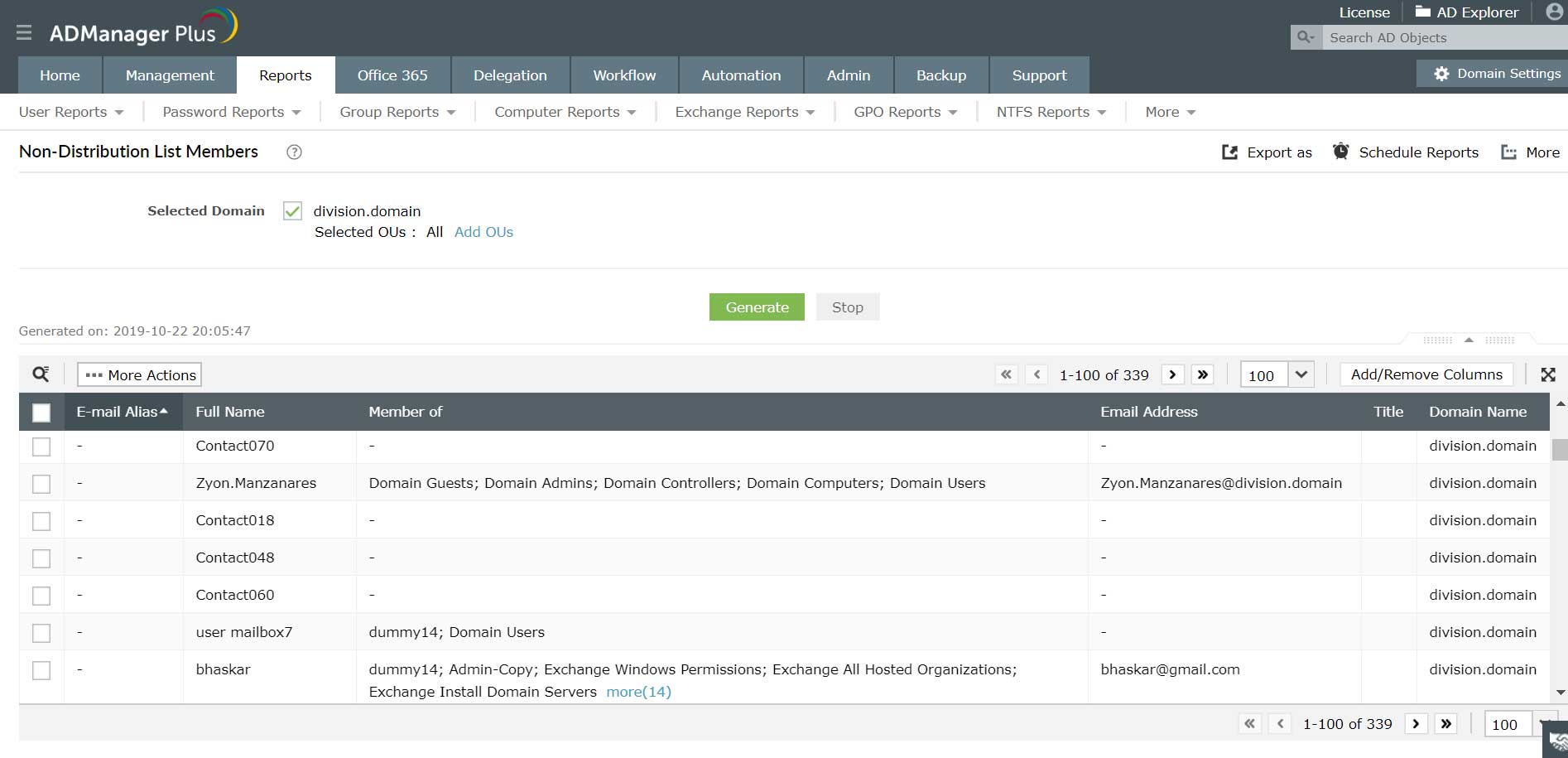
The Active Directory Exchange Reports provides a quick insight into exchange attributes of the users and members of the distribution and non-distribution lists. This helps the administrators to validate the members and update members to or from the distribution list; view the proxy addresses, email addresses, mailbox store, recipient settings, POP3 etc.
Distribution List Members
This feature gives the contacts and user details of the distribution lists of the Exchange Server.

Mail enabled users Report
It provides the list of all mail-enabled users. Mail enabled users can receive messages only at an external mail address, they have no mail boxes in exchange server but still their names will be populated in the global address list.
Mailbox enabled users Report
It provides the list of all mailbox-enabled users. All mailbox-enabled users have a mailbox in microsoft exchange server.
Users hidden from exchange address lists Report
In organizations with large networks some mail addresses are kept confidential and would not be populated in the Global Address List. This report provides the list of all users whose mail addresses are hidden from exchange address list.
POP3 Disabled Report
This provides the list of POP3 disabled users. For the attribute “protocolSettings” LDAP contains different values, ADManager Plus retrieves the respective value for POP3 disabled users and provides the list.
IMAP4 Disabled Report
This provides the list of IMAP4 disabled users For the attribute “protocolSettings” LDAP contains different values, ADManager Plus retrieves the respective values for IMAP4 disabled users and provides the list.
The complete list of Exchange Server based reports:
Financial Insights Releases Global Stock Exchange Update; New York Stock Exchange is Now the...
The report discusses the recent failures of Deutsche Borse, Euronext, Maquarie Bank, and Nasdaq to achieve a merger with the London Stock Exchange (LSE). Financial Insights believes that New York Stock Exchange (NYSE) is now well positioned to accomplish what others have not, even in the face of further challenges from Nasdaq. Financial limitations of the players, regulatory issues, and cultural biases will each play a role in how this dance unfolds.
"Consolidation in the United States and Europe will continue to be a fact of life over the next 5-10 years. As the largest exchanges become even larger through mergers, look for the smaller national and regional exchanges to find ways to remain relevant. This will occur either by partnering/merging with the larger exchanges or by trying to develop technology that will give them an edge in wrestling away small pieces of the pie," said Randy Grossman, research manager, Capital Markets at Financial Insights.
The research further analyzes the potential for consolidation of national exchanges in Asia. Financial Insights predicts very limited consolidation, however partnerships and strategic alliances will continue. In addition, the Tokyo Stock Exchange will be investing heavily in its infrastructure to prevent a recurrence of its recent technology meltdowns.
For more information on obtaining this report, Shall We Dance?: Global Stock Exchange Update (Financial Insights, FIN201524, May 2006), please contact: sales@financial-insights.com.
About Financial Insights, an IDC Company
Financial Insights provides independent research, custom consulting, and detailed multiclient studies on the technology issues and challenges facing the financial services industry. Our global research covers topics of strategic importance to corporate and retail banks, insurance carriers, asset management firms, securities and brokerage firms. Our local practices in Asia Pacific, Europe, Latin America and Canada add an in-depth regional viewpoint. Financial Insights, an IDC company, is headquartered in Framingham, Massachusetts, USA. IDC is a subsidiary of IDG, the world's leading IT media, research, and exposition company.
For more information visit: http://www.financial-insights.com.
investments Macedonian Stock Exchange - Daily Report - Mar 24, 2009

Тhe Macedonian Stock exchange has published its daily report on turnover and prices for March 24, 2009.
The document contains the following tables:
OFFICIAL market
Super Listing - ordinary shares (table)
Super Listing - preference shares (table)
exchange Listing - ordinary shares (table)
exchange Listing - preference shares (table)
exchange Listing - bonds (table)
REGULAR market
market of publicly held companies - ordinary shares (table)
market of publicly held companies - preference shares (table)
Free market - ordinary shares (table)
Free market - bonds (table)
Total Turnover all market segments (table)
*****
To view the original document, please click on the link bellow:
http://reports.aiidatapro.com/MKSE/Mar_24_2009_Daily_Report.xls
*****
AII Data Processing does not endorse in any way, the views, opinions or recommendations expressed above. The use of the Information is subject to the terms and conditions as published by the original source, which you have to read and accept in full prior to the execution of any actions taken in reliance on Information contained herein.